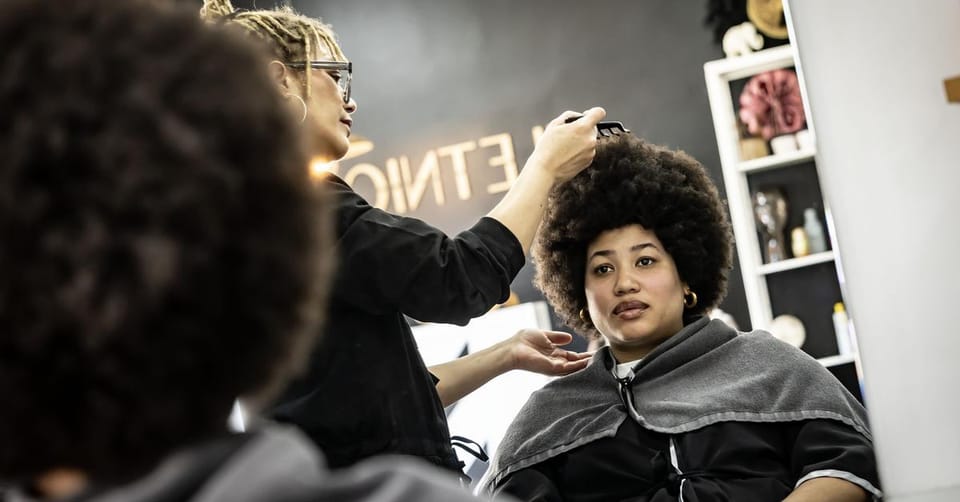
Afro-descendant women across Barcelona are actively reclaiming their natural hair, defying traditional beauty norms that often stigmatise textured hair. This movement sees women embracing their curls and coils, supported by a growing network of specialised salons and product stores dedicated to Afro hair care.
The Journey to Natural Hair
Isabel Balde, 32, born in Barcelona with Dominican and Guinea-Bissau heritage, experienced this journey firsthand. She admits feeling constantly observed and tired of strangers touching her hair without permission. Balde recalls her mother applying an aggressive chemical product monthly for two hours. This scorched her hair, yet achieved temporary straightening. She also avoided wetting her hair at the beach to prevent it from curling. Balde only washed her hair when her mother had time to straighten it with a hairdryer. She eventually underwent a “transition” after moving out, cutting her damaged hair almost to zero. “It was horrible. I did not leave the house for two weeks,” she confessed. Now, Balde lives in Madrid but travels to Barcelona for her haircuts, embracing her natural Afro hair.
Specialised Salons Foster Empowerment
Balde’s hairdresser is Tamy Ferràs, 48, owner of Iletnic, a salon in Barcelona’s Nou Barris district. Ferràs, who also has Afro hair and specialises in its care, states that her entire life has revolved around her hair. She felt different and excluded from Catalan society, where the majority population is white. “I was obsessed with my hair moving and being long,” Ferràs explained. She notes that many of her clients share this sentiment. Ferràs aims to make her clients recognise the inherent beauty of their natural Afro hair. She reports that 95% of her clients now choose to wear their hair naturally.
Fàtima Seriki, 41, with a Nigerian father and Barcelona mother, is another Iletnic client. She wore braids or used gel to flatten her hair until she was 28. “My lifelong African hairdresser did not support me when I said I wanted to wear my hair naturally,” Seriki lamented. She now proudly displays a voluminous, splendid curly hairstyle. However, not all women feel comfortable wearing their natural hair in all settings. Rebeca, 32, born in Germany with Sierra Leonean and Liberian parents, chooses to wear straight extensions. “I would like to wear my natural hair,” Rebeca stated, “but I work in a company where I am the only Black person.” She noted that her sister and friends experienced their Afro hair being deemed unprofessional at work.
Challenging Societal Stigma
Penda Mboup, from Senegal, works with Ferràs and expertly applies extensions. She carefully braids Rebeca’s hair before sewing in the straight extensions. Desirée Bela-Lobedde, an anti-racist education writer and speaker, highlights the societal perception. “One thing is to be white and have curly hair, another is to be Black and have it curly,” Bela-Lobedde explained. She added, “In many places, people believe that if you are Black and have curly hair, you are lower class because you lack money for salon straightening.” The constant media portrayal of white women with long, straight hair as the beauty ideal further exacerbates this issue. Michelle Obama, for instance, wore her hair straight during her time as US First Lady. She confessed in a book that American society “was not ready” to accept her natural Afro hair. Irish writer Emma Dabiri explores this in her essay, Don’t Touch My Hair: The Origin and History of Afro Hair. She argues that Afro hair has historically faced stigmatisation and modification, serving as both a symbol of oppression and liberation for the Black community.
Health Risks and Specialised Care
Bela-Lobedde also warns about the health implications of chemical straighteners. “In Africa, people often use chemical products to straighten hair. These contain hormonal disruptors that can cause uterine fibroids or breast cancer,” she cautioned. Bela-Lobedde herself underwent a “transition” after years of straightening. She now wears her hair naturally. She stresses that Black individuals, whether wearing straight or Afro hair, must care for it properly. This requires both time and money. Specific products are necessary for straightening, detangling, curl activation, or soothing irritated scalps from braids. Shampoos, conditioners, masks, dyes, sleeping caps, extensions, and wigs are all part of this regimen.
La Bella Cosméticos, a chain specialising in Afro hair products, operates stores in Barcelona and Santa Coloma de Gramenet. It opened approximately 15 years ago as a pioneer. Now, many similar shops exist, often owned by Pakistani individuals. Most Afro hair products are imported from the UK, the US, and Latin America, with few originating from Africa. Carlos Castelli, manager of the Sepúlveda street store in Barcelona, noted the higher cost of these specific products. “For example, hydrating lotions are made from avocado or shea butter. They would be too greasy for a white person’s hair,” he explained. Castelli estimates that 50% of his clients have Afro hair, and half of these purchase wigs. The store features shelves filled with plastic heads displaying various wigs: short, long, curly, straight, brown, black, blonde, and even brightly coloured options. Synthetic wigs cost around 60 euros, while natural hair wigs range from 400 to 700 euros.
Wigs and Protective Styles
Flor Alba, a client from Cuba with Afro hair, consistently wears wigs. She finds them comfortable and believes they enhance her personality. “I wear them for comfort and because they give me personality,” she stated. “Depending on what I am wearing or my mood, I put on a different one. I have fourteen wigs at home.” She uses shorter wigs for work and more striking ones for special occasions. During her visit, she chose a long, lilac and fuchsia wig, expertly changing it in seconds. Rosa Mangue, 39, from Equatorial Guinea, owns Rosy Style salon in Parets del Vallès. She explains that wigs are a cultural norm for Black women. “For the Western European woman, the wig is a taboo. For us, however, it is just another accessory,” Mangue clarified. “We have fully integrated it; it forms part of our culture.” Her salon, designed to empower women, focuses on “protective styles.” These methods, such as wigs, braids, and crochet, reduce daily hair manipulation. Mangue, trained in England, specialises in the Afro-American crochet technique. This involves braiding hair close to the scalp and then inserting and knotting curly or wavy extensions to create a full head of hair. These high-quality synthetic fibre extensions look natural, can be washed and styled, and last two to three months.
Beatriz Fernández Adiko, 33, born in Sabadell with Ghanaian and Andalusian heritage, has used the crochet technique for ten years. She previously tried chemical straighteners, which caused scalp scabs. “As a child, people told me my hair was a scourer,” she confessed. She now sports impressive curly hair. Marga Mbande, 46, born in Barcelona to Equatorial Guinean parents, also uses the crochet technique. She remembers her mother straightening her hair with a metal comb heated over a fire, effectively burning it. This “hot comb” was a traditional tool in the Black community. In L’Hospitalet de Llobregat’s Can Serra neighbourhood, Anita Lou, 31, from Ivory Coast, runs Belleza Afro Europeo. She opened her salon in 2019, serving her community while carrying her nine-month-old son, Alejandro, on her back in the traditional African style.
This growing movement in Barcelona signifies a profound cultural shift. It empowers Afro-descendant women to embrace their authentic selves, challenging ingrained beauty standards and fostering a vibrant community around natural hair care and identity. The increasing number of specialised salons and product providers reflects a sustained demand for services that celebrate and cater to Afro hair, moving towards greater acceptance and pride within the city.
Come and join our Barcelona English Speakers community on WhatsApp.
Originally published by Ara Cat. Read original article.