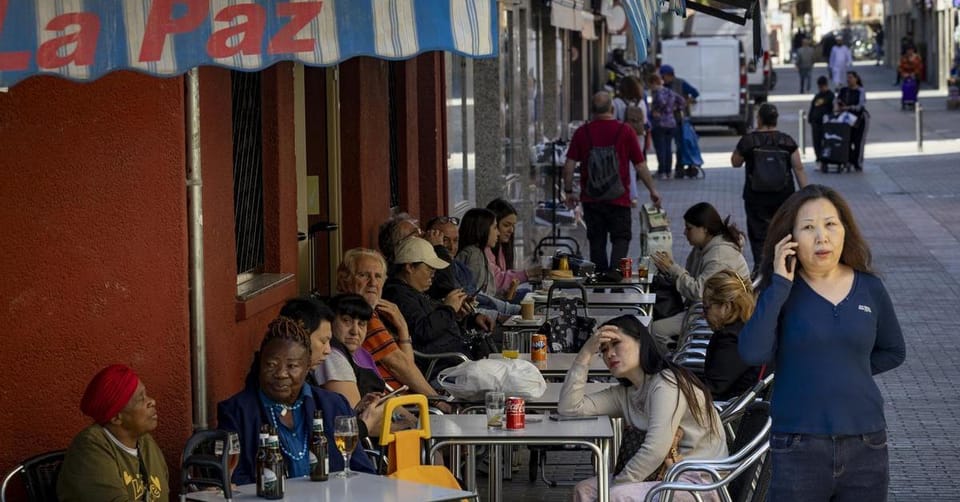
Even with a good income, Atusa Khan and her family struggle to find suitable housing in Barcelona. Their experience highlights widespread residential segregation. This affects immigrant communities across Catalonia. New data from the National Institute of Statistics (INE) reveals this complex issue. It impacts both low-income and affluent residents. This coincides with the start of an extraordinary regularisation programme. The programme targets 150,000 people living and working in Catalonia.
The Khan family, with two young daughters, currently sublets in Barcelona’s Raval district. This area has a 64% foreign-born population. Atusa Khan expressed her frustration. She stated, "Not even with money can I live where I want." Meanwhile, the Martínez Mejía family has faced four mortgage rejections. This occurred despite the combined income of four working members. They continue to rent a dilapidated flat in La Torrassa, L’Hospitalet. Over half, 54%, of residents in La Torrassa were born abroad. One son, in his twenties, shares a room with his parents. This is due to the flat's small size. Lucila Rodríguez-Alarcón, Director General of Fundación PorCausa, summarises the situation. She states, "You live where you can and where they let you live." This reflects the reality for many.
Real Estate Racism Shapes Neighbourhoods
The issue extends beyond low-income groups. Wealthier immigrants also experience segregation. The Johnson family, from California, settled in Barcelona’s Gràcia district after the pandemic. Gràcia has a 31% foreign-born population. They pay rent nearly four times the interprofessional minimum wage. They also purchased two flats. They sold one and renovated another for seasonal rental. Their social life remains within an English-speaking circle. Their teenage daughters attend an international school. Rodríguez-Alarcón identifies "ghettos of rich immigrants" within the city. These facilitate physical isolation. Geographer José Lasala indicates that "the greatest segregation occurs in more affluent neighbourhoods because it is a voluntary separation." Conversely, individuals with less economic capacity end up in more disadvantaged areas.
Aliou Diallo, a researcher at the University of Girona, highlights "real estate racism." He describes it as a "structural" practice. Diallo recently published a report on this issue, commissioned by the Catalan Government. He states that real estate agencies have become "agents that design neighbourhoods." They decide who can live where. Diallo asserts that racialised individuals, even with Spanish passports, are "by default" perceived as impoverished. Agencies believe they "will lose value" for the building. Even with "proven solvency," these individuals are sometimes offered flats "in poor condition or needing complete renovation." This practice contributes significantly to residential segregation.
Segregation Across Catalonia's Urban Landscape
Catalonia is home to two million foreign-born residents. This represents 25% of the census. These individuals primarily concentrate in large cities within the Barcelona metropolitan area. Smaller concentrations appear in the periphery. However, some exceptions exist. Guissona, Salt, and La Jonquera show rates well above the Catalan average. Outside the greater Barcelona conurbation, physical segregation is more complex in smaller or medium-sized towns. This is due to their dimensions. Lasala notes that symbolic barriers replace physical ones. A sense of "urban legitimacy" emerges. Some groups feel entitled to occupy certain areas. Others stigmatise these areas and avoid them.
Jordi Bayona, a Professor at the University of Barcelona (UB) and an associate researcher at the Centre d’Estudis Demogràfics, prefers the term "concentration" over "ghetto." He believes "ghetto" criminalises people. Bayona agrees that Catalonia's concentration level is "medium." It is likely lower than decades ago. At that time, newcomers lived in shantytowns or segregated industrial estates. Immigration in Catalonia is "structural." It increases with economic prosperity and slows during crises. Bayona stresses the need for a prepared reception system. He also notes that integration levels depend on the time of arrival. "Those who arrived 10 or 15 years ago probably did not have as many problems finding a rental as those arriving now," he reflected.
Policy Failures and Social Networks
Lasala identifies three factors indicating a neighbourhood's segregation level. These are residents' birthplace, education level, and disposable income. These three factors "go hand in hand." They distribute the population across neighbourhoods. Rich live with rich, and poor live with poor, regardless of nationality or origin. Lasala concludes, "If housing stratifies, the population ends up stratifying." He warns that administrations repeat past errors. They concentrate the few public housing developments in specific neighbourhoods or peripheral city zones. This occurs despite the lessons from decades ago. A "savage real estate market" leaves poor immigrants with few options. They must live in socially disadvantaged areas. These areas offer poorer quality, smaller, and older homes. They suffer from years of underinvestment and degradation. Eventually, only those with no other choice will live there.
Rodríguez-Alarcón also emphasises the need for policy changes. These changes should foster "social mix." They must avoid approaches seen in France or Belgium. Those countries created extensive public housing for post-colonial immigration. This concentration led to "ghettos" and social confrontation. These issues persist today. She adds that quality "public services" eliminate segregation. They "equalise everyone." They facilitate shared spaces, such as schools or medical centres. Lasala sees a danger in rising property prices. Ultimately, the most vulnerable residents, with the least power to choose, suffer the most.
Future of Barcelona's Diverse Communities
The pattern of following acquaintances is common in all migrations. Lola González, an octogenarian in Martorell’s Buenos Aires neighbourhood, shared her story. She came from a village in Seville sixty years ago. Friends helped her find a room. Three couples shared one flat. Today, young Sub-Saharan Africans in the same square share similar experiences. They speak English, a colonial language, as many come from Nigeria and Ghana. They moved to Martorell for work, often in nearby companies. They found shared sublets with compatriots in this specific neighbourhood. Rodríguez-Alarcón affirms, "Those who arrive seek a welcoming community." Word-of-mouth networks, based on shared language, culture, and customs, activate when people need to emigrate or when the host society needs labour.
Demographer Bayona notes that degraded neighbourhoods change resident demographics over time. As older residents age or move, younger foreign-born populations move into many flats. This creates a "coexistence that is not only of different origins but also of different ages." Similar processes occur in historic city centres that have not undergone gentrification. Examples include Lleida, Manresa, or Balaguer. Girona’s historic centre, however, has gentrified. It attracted high-income European immigrants, causing housing prices to soar. In these affluent neighbourhoods, not only is housing more expensive, but shops and restaurants also raise prices. This creates invisible barriers for others. Rodríguez-Alarcón insists, "The rich also create their own spaces."
Sign up for our new entrepreneurs community Bizcelona, now accepting our second wave of applicants.
Originally published by Ara Cat. Read original article.