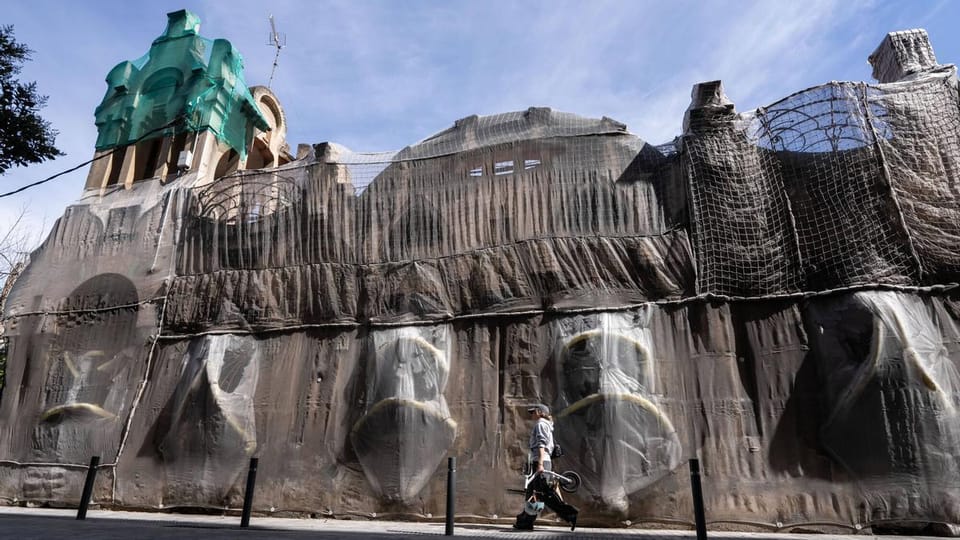
Barcelona City Council has carried out urgent stabilisation works on Casa Tosquella, a Modernista tower in the Sarrià-Sant Gervasi district. This intervention addresses the building's deterioration while its extensive rehabilitation project faces delays. The council plans to transform the historic property into a senior citizens' centre.
The municipal company Barcelona d'Infraestructures Municipals (BIMSA) awarded the urgent contract in December. Synergia Sicons completed the works, costing 26,545.66 euros including VAT, within one month. Municipal sources confirmed the intervention focused on consolidating architectural elements. These included the roof access structure and a party wall windowsill.
Workers also installed new nets and protective elements on the windows. Further work will involve a plan for structural monitoring. Beyond conservation, the project included preparing the site for its future municipal use. This involved demolishing an annex building in the garden. Operatives also removed a section of the perimeter wall. The plot will open to the public as a green square.
The full rehabilitation project is currently in the drafting phase. The municipal government expects to approve the executive project document within the next year. This approval will occur before the current mandate concludes. Deputy Mayor and Sarrià-Sant Gervasi Councillor, Maria Eugènia Gay, estimated the full rehabilitation would cost over three million euros a year and a half ago. She shared this at the Putxet i el Farró neighbourhood council.
Controversy Over Architectural Design
A significant delay stemmed from controversy surrounding the architectural proposal. This design won a competition in January 2024. The Casa Tosquella will become a senior citizens' centre. This requires installing an lift, suitable staircases, and adapted toilets. The challenge is to integrate these without altering the original interior layout.
The winning architects, Clara Solà-Morales and Metrònom studios, proposed an annexed façade at the rear. This would house the modern services. However, heritage managers and activists strongly criticised its bold aesthetic. They launched a manifesto of rejection. The initial render showed a striking turquoise ceramic façade with two medieval-style towers. It also featured a small central door and contemporary white elements.
This addition would cover the less ornate side of the property. It would be the most visible from Ronda General Mitre. The main entrance is on the smaller Vallirana street. The City Council promised to revise the design with the architects. They also assured approval from the Generalitat de Catalunya before works began.
Revised Plans and Public Reaction
In July, the winning architects shared images of a revised model on Instagram. These images showed several unannounced changes. The new façade softens the towers and initial undulation. It now appears less monumental. It can also be lower, as the Generalitat and City Council agreed the roof would not be accessible.
The revised design also shortens on the right. This reveals more of the house's original profile. The crowning elements from the initial render are absent from the model. The model also shows no colours. In November 2025, the district presented these new images to the critical manifesto's proponents.
Maria-Cruz Santos, from the manifesto's promoting group, expressed continued dissatisfaction. She stated, "It still doesn't appeal to me, because these walls with so much personality continue to overshadow the house; it won't be visible from Mitre." Santos also noted, "They had told us that works would begin in September 2025, but it remains behind nets."
However, Santos praised the removal of the auxiliary garden shed. She said it "had no value and caused cleanliness issues." She also approved the removal of old appliances. "The last resident must have modified the kitchen for what she needed in the last stage of her life; what remained to be removed were just old items, because the antique furniture was already taken out for preservation," she explained.
A Rich Modernista History
Eduard Maria Balcells i Buigas, a notable architect, designed Casa Tosquella in 1889. The building exhibits Modernista, Arabesque, and eclectic elements. Balcells i Buigas belonged to a prominent Barcelona family. He was the nephew of Gaietà Buigas, who designed the Columbus Monument. He was also a cousin of Carles Buigas, creator of the Montjuïc Fountain.
The Indiano merchant Antoni Tosquella commissioned the house. He desired a summer residence in Sarrià, a popular trend at the time. The property faced demolition in the 1970s during the construction of Ronda General Mitre. Maria Dolors Castells, a Tosquella descendant and the last resident, worked tirelessly to ensure its cataloguing.
After Castells' death, the house was listed for sale in 2019 on Wallapop, a second-hand app. The City Council exercised its right of pre-emption to acquire it. This ensured its preservation as a cultural and social space. The council now aims for the full rehabilitation to occur between 2027 and 2031. This will finally see Casa Tosquella reborn as a vital neighbourhood facility.
Sign up for our new entrepreneurs community Bizcelona, now accepting our second wave of applicants.
Originally published by El Periódico Barcelona. Read original article.