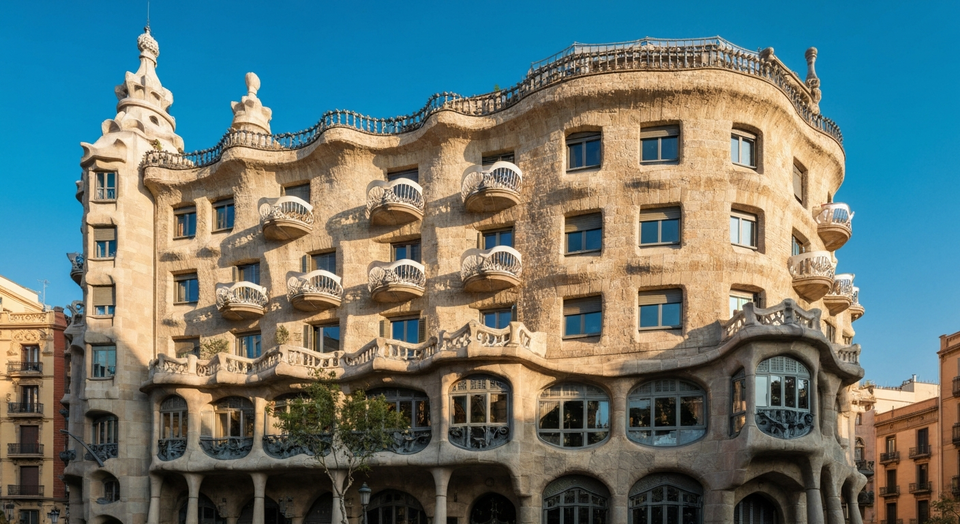
Barcelona's iconic Casa Milà, widely known as La Pedrera, stands today as a celebrated architectural masterpiece by Antoni Gaudí, but its innovative and organic design was initially considered highly impractical for daily living by its early 20th-century residents, according to a report by 20 Minutos Barcelona.
More than a conventional home, Gaudí conceived an interior universe where sophistication took precedence over practicality. Entering the building must have felt like stepping into a theatrical space. The rounded rooms, featuring few corners and undulating walls, completely broke from the classical bourgeois housing typical of the Eixample district.
Nothing adhered to the logic of a perfect rectangle, including the living rooms, bedrooms, or even the internal pathways. This organic geometry combined with exceptionally high ceilings, adorned with mouldings and reliefs, transformed the upper part of each room into a decorative element in its own right. These were not mere ceilings; they extended the building's sculptural language, creating an almost palatial sense of spaciousness.
Organic Interiors and Custom Details
This design, however, reinforced the impression of a house built more to astonish than for everyday life. A revealing detail of this sophistication lay in the doors and windows, which featured custom-designed, handcrafted fittings rather than standard pieces. Each door possessed its own formal language, integrated with the wood, frame, and the space's curvature. Even opening a room became part of an aesthetic experience.
This level of personalised detail, which now signifies extreme luxury, could prove less functional for residents. The house imposed its conditions, requiring inhabitants to adapt to the unique spaces. Noble materials further enhanced this sense of exclusivity. Solid woods, artisanal wrought iron, worked stone, and decorative plasterwork made each room a coherent composition, where architecture, carpentry, and decoration spoke the same language. Nothing appeared improvised; everything formed part of a total work of art.
Advanced Ventilation Systems
The official @lapedrera_barcelona social media account highlights that much of the building's value stems from this absolute integration between design and domestic use, a highly advanced concept for its era. The residence was not merely a container but a complete spatial experience. Similarly, the main rooms often featured oak and poplar parquet flooring, specifically designed to conform to the house's unique shapes.
Another distinctive feature was its excellent ventilation, uncommon in early 20th-century bourgeois Barcelona. Gaudí organised the flats around two large interior courtyards, promoting a constant flow of air. This allowed for highly effective cross-ventilation between rooms. Consequently, even the most interior rooms breathed better than many properties in the Eixample, where central spaces often remained darker and stuffier. In summer, this air circulation must have provided a significant difference, offering a notable sense of coolness.
Rooftop Sculptures and Public Perception
On the rooftop, Gaudí elevated his concept of dignifying the functional to an almost sculptural extreme. Chimneys and ventilation towers, originally conceived as purely technical elements, transformed into monumental pieces that now define Casa Milà's silhouette. Their sinuous volumes, clad with undulating surfaces and finials resembling helmets or visors, have for decades inspired comparisons to petrified soldiers guarding the city from above. Gaudí did not conceal function; he beautified it, turning smoke outlets and ventilation shafts into a sculpture garden demonstrating how even the most utilitarian elements could acquire an artistic dimension.
Paradoxically, this very sophistication also sparked criticism. For some in Barcelona society, the building's rough stone appearance earned it the nickname La Pedrera, meaning “The Quarry.” Its almost obsessive details were considered excessive at the time. Compared to the classical sobriety of other Eixample properties, La Pedrera seemed an unusual and difficult-to-tame rarity. Today, however, that apparent initial discomfort is precisely what makes it so fascinating. Few homes have pushed the idea that every room, every window, and even every door handle can become an author's unique piece. More than a house, it represented a way of inhabiting beauty, even if it sometimes required sacrificing practical daily logic.
Come and join our Barcelona English Speakers community on WhatsApp.
Originally published by 20 Minutos Barcelona. Read original article.