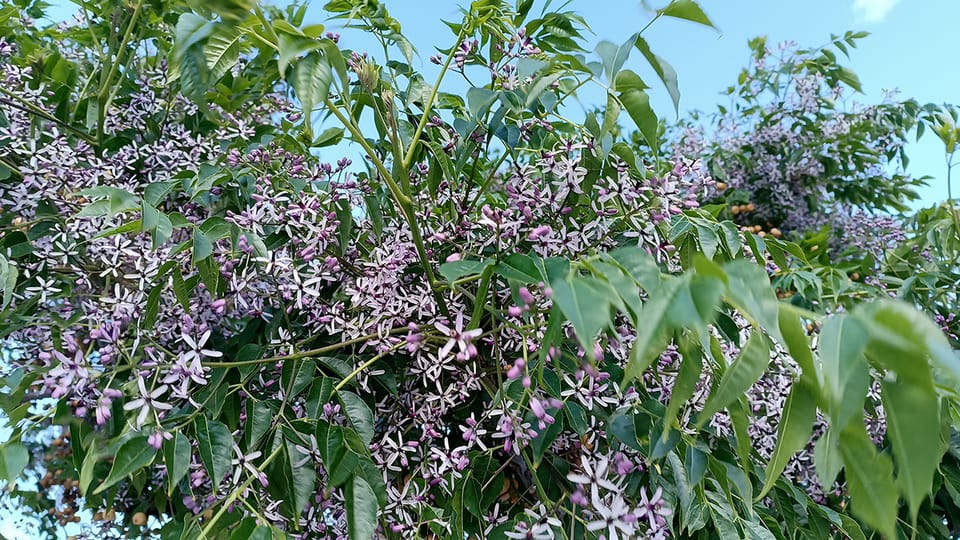
Barcelona's streets are currently filled with the intense floral scent of Melia trees, which are now in full bloom across the city. May marks the peak flowering season for these ornamental trees, transforming many avenues and gardens with their distinctive fragrance.
Residents walking along Carrer de Pere IV, between Rambla del Poblenou and Sala Beckett, will notice a strong aroma. Numerous Melia trees grow in the Jardins de Xavier Benguerel. The perfume also becomes apparent near the Sagrada Família. Many specimens grow there at street level and in the basilica's surrounding gardens. This powerful scent often makes its presence known from dozens of metres away, even before the trees come into view.
Melia's Distinctive Presence in Barcelona
The Melia azedarach, commonly known as the Chinaberry tree, is native to Asia. Its origins lie in Persia, parts of China, and the lower Himalayas. Arab settlers introduced this species to the Iberian Peninsula centuries ago. It thrives in temperate zones with hot summers and mild winter frosts. The tree requires abundant sunlight and adapts well to various soil types. In New Delhi, India, Melia trees typically flower in early to mid-March, significantly earlier than in Catalonia. However, May consistently serves as the month of the melia in Barcelona, making it one of the city's most fragrant trees.
Melia trees can grow over 10 metres tall, featuring large, compound leaves. Their flowers group into showy clusters, creating attractive bouquets. The tree produces a drupe fruit, a small, round berry about one centimetre in diameter. This fruit changes from green to yellowish-brown. These fruits form large clusters that remain on the tree throughout winter, even after the leaves have fallen. Historically, people used the fruit, which has a natural hole, to make rosaries. The fruit is poisonous to humans if consumed in large quantities, but birds can eat it safely.
Urban Planning and Environmental Considerations
Barcelona primarily uses the Melia tree for ornamental purposes, valuing its generous shade. City planners often plant it along promenades and avenues. You can find thriving examples in Plaça de la Sagrada Família and Carrer de la Marina. Other notable locations include Carrer de la Selva de Mar, Carrer de Biscaia, Carrer de Quito, and Carrer de Mandri. You can also find them on Carrer Gran de Sant Andreu, Carrer d'Aiguablava, and in Parc de Diagonal Mar, among many other places.
Despite its beauty and utility in Barcelona, the Melia azedarach is considered an invasive species in several regions. These include parts of America, the Pacific, and Africa. Authorities in some countries classify it as such due to its ability to outcompete native flora. However, in Barcelona's urban environment, its role remains primarily aesthetic and functional, contributing to the city's green infrastructure.
Residents and visitors can continue to enjoy the distinctive fragrance of the Melia trees throughout May, experiencing a unique sensory aspect of Barcelona's spring.
Sign up for our new entrepreneurs community Bizcelona, now accepting our second wave of applicants.
Originally published by betevé. Read original article.