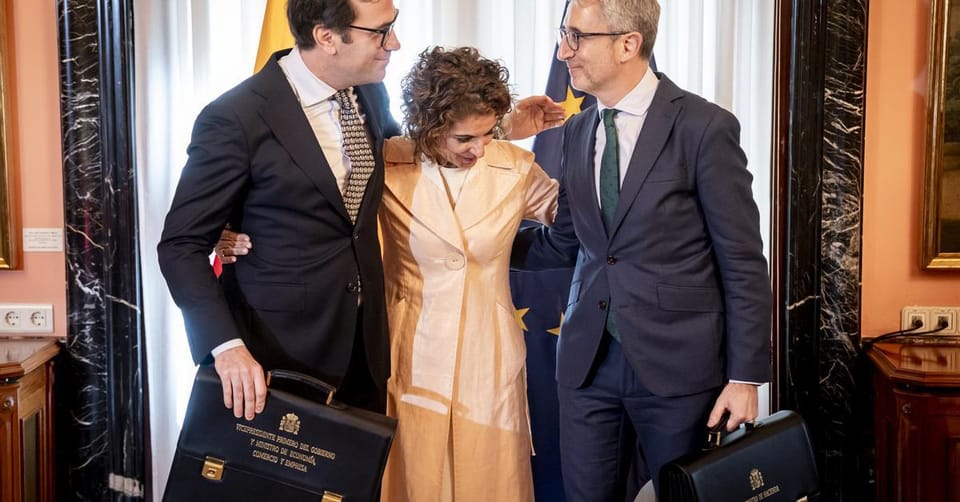
The Spanish government has firmly rejected transferring the full collection of Income Tax (IRPF) to Catalonia. This decision contradicts a previous agreement with Catalan pro-independence parties. Spain's new Finance Minister, Arcadi España, reiterated this position this week.
Minister España confirmed the government would not deviate from the agreement signed between La Moncloa and the Generalitat. This occurred during last July's Bilateral Commission meeting. "For all autonomous communities and also for Catalonia, we want to increase management capacity, always within the framework of the State Tax Administration Agency (AEAT)," España stated. He made these remarks in his first interview as minister on Cadena SER this Tuesday. This means the AEAT will retain primary competence for IRPF management and collection. The Agència Tributària de Catalunya (ATC) would only collaborate. This collaboration would be within a "networked tax management model," as outlined in the Bilateral document. This position aligns with that of his predecessor, María Jesús Montero. She previously closed the door on such transfers.
This refusal directly impacts ongoing budget negotiations. These talks are between Esquerra Republicana de Catalunya (ERC) and the Partit dels Socialistes de Catalunya (PSC). The transfer of 100% IRPF collection was a crucial point. It formed part of the agreement reached between ERC and PSC for the investiture of PSC leader Salvador Illa.
IRPF Transfer Remains Blocked
The original agreement, made in summer 2024, stipulated that the ATC would collect 100% of IRPF. This was initially set to begin in 2026. The timeline was later adjusted to January 2028. This acknowledged Catalonia's administrative unpreparedness for such a large undertaking. However, the Spanish government must modify tax law for this to happen. It has expressed no interest in doing so. Spanish President Pedro Sánchez had already informed ERC President Oriol Junqueras in late February. He stated there was no scope to fulfil this pact. Former Finance Minister Montero personally telephoned Junqueras. She reinforced that the ATC would not collect IRPF. This led to ERC's refusal to approve Illa's budgets. Now, ERC and PSC are negotiating again. They have removed the IRPF transfer as a "red line."
New Demands for Catalan Infrastructure
During a conference in Sabadell this Wednesday, Oriol Junqueras made a new demand. He called for an "explicit commitment" from the Catalan Government. ERC requires this commitment to build the future orbital train in Catalonia. This proposed train would connect Vilanova i la Geltrú with Mataró. It would pass through cities like Sitges, Vilafranca del Penedès, Martorell, and Sabadell. This demand comes as part of the ongoing budget discussions.
Exploring Alternative Concessions
Beyond budget discussions, both socialist and republican parties are seeking alternative concessions. These aim to satisfy ERC voters. A significant transfer of sovereignty could unlock the 2026 budgets. The most advanced proposal involves an investment consortium. This would be a joint Generalitat-State structure. This consortium would oversee the execution of investments in Catalonia. Historically, investments in Catalonia have been below societal needs. The current Spanish government acknowledges this fact. This initiative will soon begin processing in the Congress of Deputies. However, ERC has indicated this alone will not suffice for their support.
The transfer of Rodalies commuter rail services remains another unresolved issue. A joint company between the Generalitat and Renfe has been established. This company would manage the service. However, many detailed aspects still require resolution.
Progress on Airport Authority
The Parlament also discussed the creation of the Airport Authority of Catalonia this Wednesday. This authority would grant the Generalitat a significant role. It would participate in governing Catalan ports and airports. The executive council approved its creation several months ago. President Illa responded to republican questions. He assured that this would be possible "in a fairly immediate horizon." This new body also forms part of the investiture agreements awaiting materialisation.
Meanwhile, the PSC and ERC observe the Spanish government making new agreements with the Basque Country. These agreements cover significant areas. They include unemployment benefit management and Basque airport operations. The ongoing negotiations highlight the complex political landscape in Catalonia and Spain. Parties continue to seek common ground on financial autonomy and infrastructure projects. This will shape future governance and public services in the region.
Sign up for our new entrepreneurs community Bizcelona, now accepting our second wave of applicants.
Originally published by Ara Cat. Read original article.