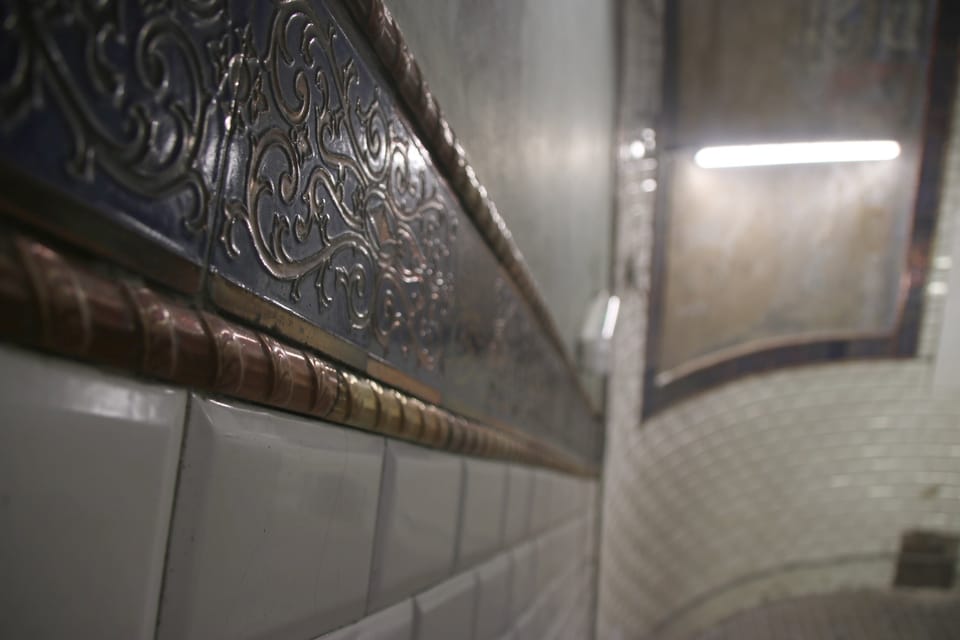
A hidden century-old spiral staircase, part of the original 1926 design of Barcelona's Urquinaona Metro station, was recently revealed to the public. This historic feature, once a main access point, offers a glimpse into the city's early underground transport system.
Transports Metropolitans de Barcelona (TMB) opened the staircase for visits last September and October. It formed part of a wider initiative to show historical metro facilities, including the disused Gaudí and Correus stations. The staircase, now behind a closed door and used by TMB staff, retains four sections. "Històries de Barcelona" explained last autumn that the walls still display original white bevelled tiles and blue Valencian ceramic tiles. These tiles once framed large advertising signs.
The Urquinaona station first opened on 19 December 1926. It was part of the Gran Metro de Barcelona's second branch, connecting Jaume I and Aragó stations, now known as Passeig de Gràcia. Original access to the underground was through an iron and glass edicle in Plaça d'Urquinaona. This edicle housed both the spiral staircase and a paid elevator.
Early Metro Accessibility
TMB noted in a publication celebrating the second branch's ninetieth anniversary that the edicle featured many cast and forged iron elements. Only the building's base was stone. The Urquinaona station was the third in Barcelona to have an elevator, following Lesseps and Fontana stations. The edicle protected these elevators, with Urquinaona's featuring a galvanised roof for waterproofing. This structure also contained the ticket office.
However, the edicle was demolished in 1972, and the elevator disappeared with it. The current access to the L4 line from Plaça d'Urquinaona dates from that year. In summer 2024, workers removed a false ceiling on the platforms. This work allowed the recovery of more original tiles from the 1926 period. The site of the former edicle is now occupied by a news kiosk.
Future Accessibility Plans
The current Urquinaona Metro station serves both the L4 and L1 lines. A corridor, also from the 1970s, connects these lines. This passageway is inconvenient and inaccessible for people with reduced mobility due to its many stairs. The L1 line at Urquinaona opened on 19 December 1932, six years after the Gran Metro extended to Jaume I.
This was part of the Metropolitano Transversal line's expansion, which began operations in 1926. Its initial section, La Bordeta to Catalunya, spanned 4,063 metres and included nine stations. These stations were La Bordeta, Mercat Nou, Sants (now Plaça de Sants), Hostafrancs, Espanya, Rocafort, Urgell, Universitat, and Catalunya. The L1 access at Ronda de Sant Pere and Carrer de Bruc still preserves iron railings and pinnacles from nearly a century ago. Despite its historical provision, the current Urquinaona station lacks an elevator. The Generalitat of Catalonia issued a tender last spring to draft a project for adapting the station. This project aims to improve accessibility for all users.
The ongoing efforts to restore and highlight historical elements, alongside plans for modern accessibility, show Barcelona's commitment. The city aims to preserve its rich transport heritage while improving its infrastructure for future generations of residents and visitors.
Sign up for our new entrepreneurs community Bizcelona, now accepting our second wave of applicants.
Originally published by Tot Barcelona. Read original article.