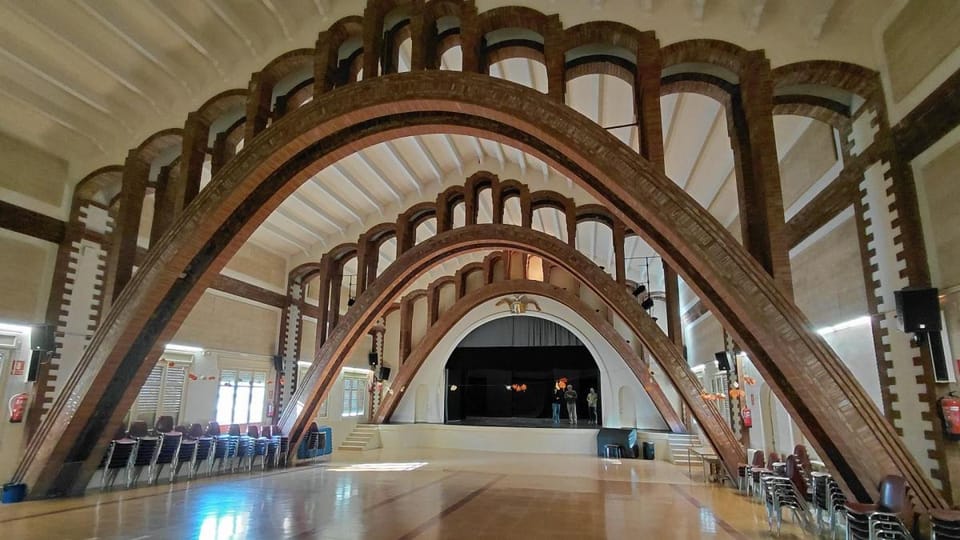
Barcelona's Cavall Bernat school, located on Rambla Badal in the Sants district, reveals a fascinating past as an educational institution founded and managed by a private metro company for its employees' children. This unique history highlights a period when private companies played a significant role in providing social welfare services to their workforce within the city.
Established in 1945 as Escuelas Comerciales Montserrat, the school was an initiative of the social department of the Transversal company. This company built one of Barcelona's two original private metro lines, which later became the foundation of the current Line 1 of the city's extensive underground network. The name Montserrat explains the references to the Virgin and the mountain found on some surviving school crests.
Initially, classrooms occupied a building on Carrer Jocs Florals, also within the vibrant Sants neighbourhood. The first academic year, commencing on 15 October 1945, offered only grammar, arithmetic, and music classes, according to historic OSSA VI projector. By the following year, the first 40 students received a full, regulated curriculum, demonstrating the programme's early success.
Metro Company's Educational Vision
The metro company's educational venture proved highly successful and expanded rapidly. In 1948, the school relocated to a new, purpose-built facility at number 113 Carrer Badal, its current location. At that time, the street had not yet received its "Rambla" designation. This site sits strategically between the present-day Mercat Nou metro station and the now-defunct La Bordeta station, reflecting its deep connection to the metro system.
The school provided free education to the children of metro workers, a significant benefit for families. Additionally, it offered evening classes specifically for company employees, fostering continuous learning. The metro company further supported its community by establishing scholarships, enabling promising students to pursue higher education beyond the school's curriculum.
In 1961, the Barcelona City Council absorbed both private metro companies, Transversal and Gran Metro. Gran Metro had formed the basis of today's Lines 3 and 4. The resulting public company saw a substantial increase in employee children eligible for the school, necessitating significant expansion of the facilities. By the mid-1960s, the school accommodated up to 250 students, reflecting its growing importance.
Transition to Public Ownership and Unique Features
During the 1985-86 academic year, the metro company formally transferred the school and its land to the Barcelona City Council. The institution then adopted its current name, Cavall Bernat, after Montserrat's most iconic peak, a nod to its original "Montserrat" designation. This transition marked its full integration into Barcelona's public education system.
The school's most striking architectural feature is a beautiful theatre adorned with arches of a distinct Gaudí-esque style. While the architect's name has not survived, their strong influence from Antoni Gaudí, Barcelona's renowned modernist architect, is clearly evident in the design. This architectural detail adds a unique cultural layer to the school's historical significance.
This specific model, designed and sold between the late 1950s and early 1960s, played a crucial role in the development and operation of many cinemas across Catalonia during that era. This highlights the school's unexpected link to cinematic history. The theatre includes a small projection room, which is now disused.
The Cavall Bernat school stands as a remarkable testament to Barcelona's industrial and educational heritage. It highlights the significant role early public transport companies played in the social welfare of their workers and the broader urban development of the city. The school continues its legacy as a vital community institution.
Come and join our Barcelona English Speakers community on WhatsApp.
Originally published by La Vanguardia Barcelona. Read original article.