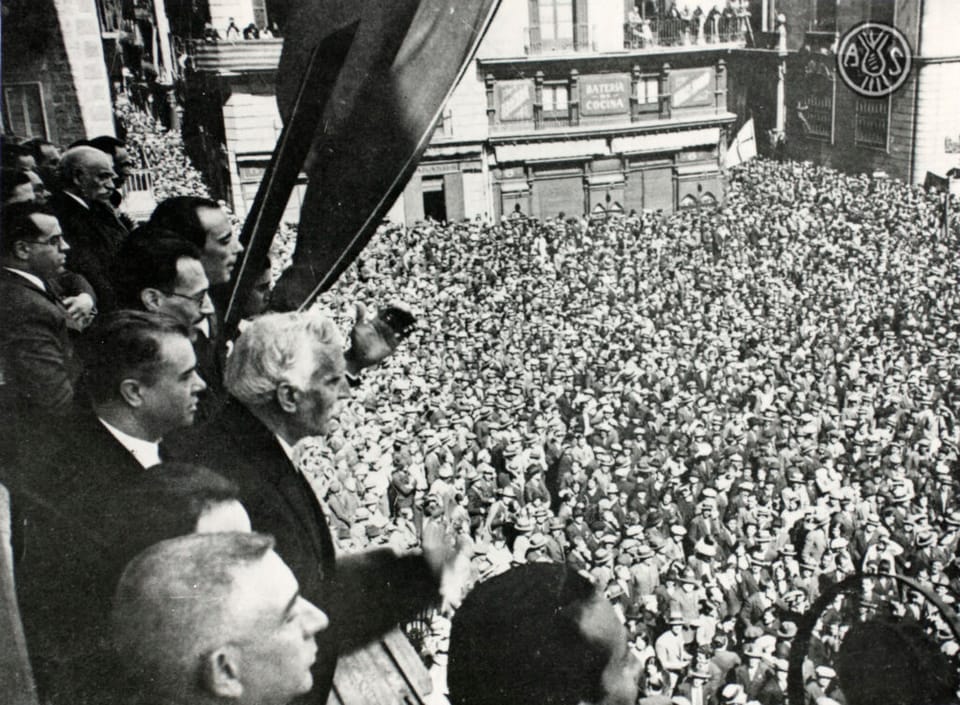
On 14 April 1931, Barcelona made history by proclaiming the Catalan State and Republic. This bold move preceded the national declaration of the Second Spanish Republic in Madrid by several hours. Key figures like Lluís Companys and Francesc Macià led a series of declarations. They spoke from the Ajuntament de Barcelona and the Palau de la Generalitat. This ignited celebrations and set a new course for Catalonia.
The groundwork for this historic shift was laid two days earlier, on 12 April. Municipal elections delivered a decisive republican victory in major Spanish cities, including Barcelona. Here, the newly formed Esquerra Republicana de Catalunya (ERC), established just a month prior, secured a significant win. Lluís Companys, a prominent ERC leader and newly elected councillor, arrived among the first at the city hall in Plaça Sant Jaume, a central square in the Gothic Quarter of Barcelona.
At approximately 13:30, Companys addressed a gathering crowd from the Ajuntament balcony. He declared, "Citizens, the representatives of the people have just proclaimed the Republic in Catalonia. We hope that you will understand the importance for the Catalan people of the act we have just carried out. I ask you to continue as before, in perfect order, for the good of the Republic and Catalonia."
Catalan State Proclaimed
Following Companys's initial announcement, events accelerated. Leaders from Estat Català, a group integrated within ERC, arrived. Dr. Jaume Aiguader, soon to be named mayor, ordered the raising of the Senyera, the Catalan flag, atop the building. Republican leaders then convened inside the Ajuntament. They made a firm decision to proclaim the Catalan Republic and appoint Francesc Macià as its president. At 14:15, Macià emerged onto the square. He addressed the assembled citizens with a more definitive declaration.
Macià stated, "In the name of the people of Catalonia, I proclaim the Catalan State, which we will cordially endeavour to integrate into the Federation of Iberian Republics, helping them to establish the new regime with all our strength." Macià also announced the formation of the Catalan Republic's government. This government was set to meet at the Palau de la Generalitat. This second proclamation introduced a key element, the declaration of a fully independent Catalan State.
Taking Control of the Generalitat
The next crucial step involved taking control of the Palau de la Generalitat. This building then served as the seat of the Diputació de Barcelona. News from Madrid remained uncertain. Fears grew that the Spanish monarch might resist abdication. This could potentially lead to a violent confrontation. Macià encapsulated the prevailing sentiment among leaders. He stated, "From here, they will only remove me dead." This reflected the real perception of the moment. There was no certainty that the army would not intervene. Barcelona's actions significantly predated Madrid's. Madrid did not raise its first republican flag until 16:30.
Defending Catalan Liberties
Once Macià had effectively taken control of the Palau de la Generalitat, he made a third, even more resolute declaration. He spoke from its balcony. He proclaimed, "In the name of the people, I have taken possession of the government of Catalonia. The people have given us their vote to govern the city, and I, in the name of Catalonia, take charge of its government and tell you that we remain here ready to defend its liberties." Macià added, "From here, they will only remove us dead. I also tell you that we must make ourselves worthy of the freedom we have just reconquered. I hope that the people will know, if necessary, to die like us to defend it." This statement underscored the determination to defend the newly established political framework.
Confrontation and Official Proclamation
Moments later, Joan Maluquer i Viladot, the president of the Diputació, demanded that the occupants vacate the building. Macià responded by invoking the popular will. This highlighted the symbolic clash between two competing legal authorities. Subsequently, they drafted and disseminated the proclamation of the Catalan State through the official bulletin of the Catalan Republic. It declared, "In the name of the people of Catalonia, I proclaim the Catalan State, under the regime of a Catalan Republic, which freely and with all cordiality yearns for and asks other peoples of Spain for their collaboration in the creation of a Confederation of Iberian peoples." The proclamation also expressed readiness "to do whatever is necessary to free them from the Bourbon monarchy."
Towards a Federal Integration
As clearer news arrived, officials confirmed the Republic's establishment in Madrid. Macià reformulated the project. He returned to the Palau de la Generalitat balcony for a final proclamation, addressing the "Catalans." He stated, "Interpreting the sentiment and aspirations of the people who have just given us their suffrage, I proclaim the Catalan Republic as an integral state of the Iberian Federation." This marked a significant shift. The earlier declaration of an independent Catalan State sought integration. Now, it was an explicit formulation as a Catalan Republic within a federal structure. Macià also appealed for order. He stated, "Everyone who disturbs public order or attempts to oppose the new regime will be considered an enemy of the Republic and Catalonia."
Legacy of a Pivotal Day
The city celebrated the advent of the Republic with flags and cheers. However, uncertainty persisted until the evening. Officials confirmed the Spanish monarch's departure then. Barcelona's proactive stance, acting without waiting for Madrid, defined the significance of these proclamations. In the following days, negotiations with the provisional Spanish government transformed the Catalan State into the autonomous Generalitat. This period initiated a complex integration. It was marked by a curtailed statute, the suspension of autonomy just three years later, and ultimately, the Spanish Civil War from 1936 to 1939. This led to decades of lost self-governance. The events of 14 April 1931 remain a foundational moment in Catalonia's modern political history. They underscore its enduring pursuit of self-determination.
Come and join our Barcelona English Speakers community on WhatsApp.
Originally published by VilaWeb Feed. Read original article.