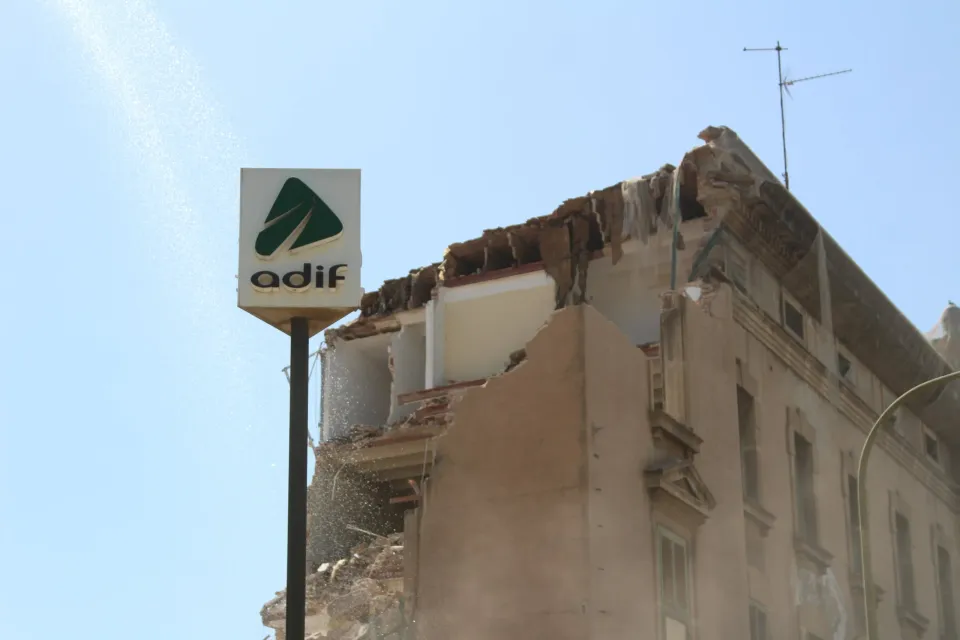
The historic La Sagrera goods station in Barcelona has been demolished this week, despite extensive efforts by local groups to preserve the century-old railway icon. Its removal paves the way for a significant urban transformation in the Sagrera district, including a new intermodal transport hub, a large green park, and thousands of new homes for residents.
Excavators razed the former freight terminal, ending months of campaigning by organisations such as the Public Transport Promotion Platform (PTP), the Terminus Transport Studies Centre, and the Barcelona Transport Museum Coordinating Association. These groups, supported by the Sagrera Neighbourhood Association and several municipal political parties, advocated for the building’s retention due to its profound historical importance. The demolition forms part of a broader urban plan that envisions a linear green park spanning the railway tracks of the new La Sagrera intermodal station. This ambitious project will create a substantial green space for the district’s growing population. Additionally, the development includes the construction of 2,230 new homes in the area, with a significant 40% designated as protected social housing, addressing a critical need in Barcelona.
A Century of Railway History
Construction of the goods terminal began in 1918, initiated by the Compañía de los Ferrocarriles de Madrid a Zaragoza y Alicante (MZA). Engineer Eduard Maristany directed the development of this crucial infrastructure. The facilities officially entered service in 1922, although they were not fully complete at that time. For nearly seven decades, until the late 1990s, this infrastructure served as Barcelona’s primary goods station. It acted as the main gateway for all train-borne freight arriving from France, playing a vital role in the city’s economy and trade.
Maristany’s Vision for Barcelona
Historian Ferran Armengol, a dedicated railway history researcher and author of “L’arrencada del ferrocarril a Barcelona, 1800-1850”, highlighted the station’s original vision. “Maristany wanted to convert Barcelona into one of the great railway capitals,” Armengol explained in a December report for TOT Barcelona. “For this reason, a monumental building was also necessary, one that would look good when people went to collect a package.” The station, alongside the Morrot station near Montjuïc, marked a significant era in the railway history of Barcelona and Catalonia. It symbolised the city’s ambition and its growing importance as a European trade hub.
Scale and Operations
At its peak, the ground floor of the building housed offices for freight invoicing and customs procedures for international transport. This facilitated the smooth flow of goods across borders. Railway worker families lived on the upper floors, creating a vibrant community within the station complex. Employees also used these spaces temporarily for service-related needs. An immense railway yard surrounded the building, covering a total area of 20 hectares. This vast yard featured tracks stretching over 15.7 kilometres in length, handling a constant flow of trains and cargo.
Preserving Historical Remnants
Today, only a porcelain sign bearing the inscription “Barcelona-Clot (Sagrera), mercancías a pequeña velocidad” (Barcelona-Clot (Sagrera), slow-speed goods) survives from the original structure. It is carefully preserved at the Railway Museum of Catalonia in Vilanova i la Geltrú, safeguarding a tangible link to the station’s past. Additionally, authorities plan to preserve another historical remnant linked to the demolished station. A Civil War air-raid shelter, discovered a few metres from the goods terminal, will integrate into the area’s transformation. This medium reported the plans in early February, confirming its future preservation.
The Civil War Air-Raid Shelter
The bunker’s exceptional state of preservation and its strategic location at one end of the urbanisation area mean its discovery has not delayed demolition or the new intermodal station’s configuration. The shelter, found last November, connected the two buildings that formed the entrance to the old goods station. It was privately owned and did not appear on the Passive Defence Board’s official list from July 1938. Historians believe the CNT, which collectivised the railway sector during the conflict, likely initiated its construction, highlighting its unique historical context.
A New Chapter for La Sagrera
The demolition of the La Sagrera goods station closes a significant chapter in Barcelona’s industrial and urban history. While the loss of this railway icon is notable, its removal facilitates the creation of vital new infrastructure and housing for the city. The new intermodal station will enhance connectivity, while the green park will improve urban quality of life. The integration of the Civil War air-raid shelter ensures a piece of the area’s past will remain accessible amidst its future development, offering a blend of progress and historical remembrance for residents and visitors alike.
Come and join our Barcelona English Speakers community on WhatsApp.
Originally published by Tot Barcelona. Read original article.