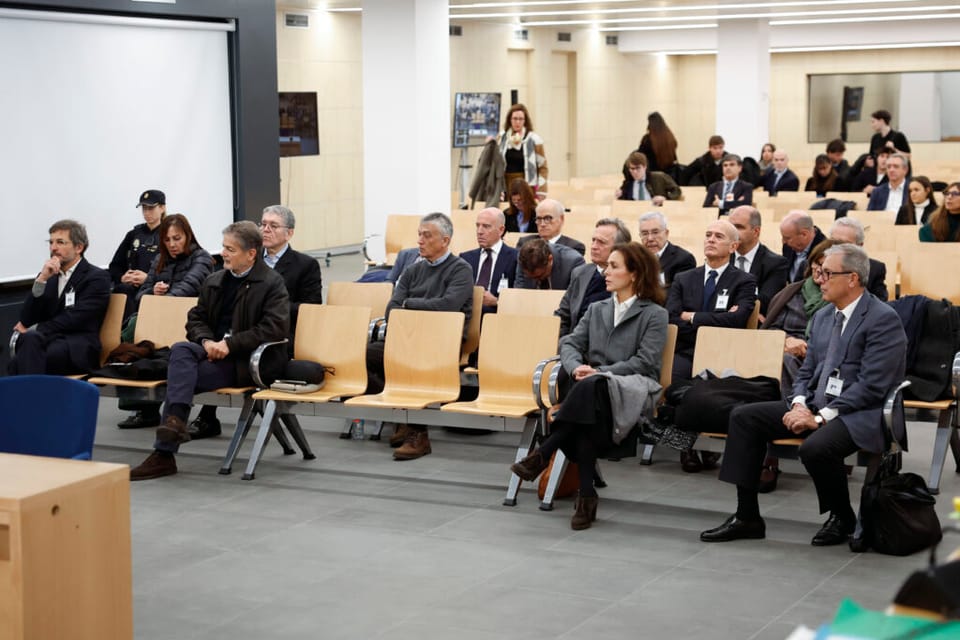
The high-profile Pujol Ferrusola trial enters its decisive phase this week at Spain's Audiencia Nacional, where the seven Pujol Ferrusola siblings and nine accused entrepreneurs will finally testify. A medical examination will determine if former Catalan President Jordi Pujol, aged 94, must also appear in court.
The court, presided over by Judge José Ricardo de Prada, scheduled a medical assessment for Mr Pujol at 09:30 on Tuesday. The judge will announce his decision on Mr Pujol's testimony at 10:00, when the session starts. Forensic doctors previously concluded Mr Pujol has moderate cognitive deterioration. This raises doubts about his physical and cognitive ability to participate in a trial and defend himself.
The trial has a strong political component, making the court's decision uncertain. The declaration phase will see the Pujol Ferrusola siblings break their long silence. Oriol Pujol, one of the sons, previously admitted to Catalunya Ràdio that having money abroad was "a shame for the family." Josep Pujol defended his father's legacy in a documentary.
Allegations of Corruption and Money Laundering
Spanish anti-corruption prosecutors accuse former President Pujol of using his political position to build a clientelist network. This network allegedly enriched himself, his family, and allied entrepreneurs connected to the former Convergència political party. Prosecutors claim the family's undeclared funds, which they attribute to an inheritance, were actually commissions. These commissions were reportedly received in exchange for granting public contracts to trusted companies.
Jordi Pujol Ferrusola, the eldest son, allegedly received substantial invoices from these companies. These payments were for "intermediation services," supposedly alerting companies to private business opportunities. A significant part of the trial's interrogations has focused on whether these services were genuine. Prosecutor Fernando Bermejo has struggled to prove they were not real.
Defence Claims and "Operation Catalonia"
The prosecution asserts the family laundered money through multiple companies in tax havens. They also used accounts in third parties' names and numerous transfers and cash deposits. This system, according to the prosecution, "allowed the Pujol Ferrusola family to distribute illicit funds and dispose of them through accounts in Andorra." The accused entrepreneurs face charges of necessary cooperation in money laundering. They allegedly falsified commercial documents to complete the scheme.
The Pujol family admits holding undeclared money abroad, which is a crime. However, their defence argues the fortune grew through investments, not commissions or fraudulent activities. Several children have also claimed the judicial process aims to "kill Pujol" politically. They link it to "Operation Catalonia," an alleged state operation against Catalan nationalism. Joan Pau Miquel, former chief executive of Banca Privada d'Andorra, told Judge de Prada that Marcelino Martín Blas, head of internal affairs for the Spanish police, threatened him to violate the Pujol family's bank secrecy. Mr Miquel reported Mr Blas said, "We are at war against Catalan nationalism."
Previous Trial Developments
Defence lawyers previously argued that fundamental rights were violated throughout the investigation. They described the prosecution's brief as "indeterminate, vague, labyrinthine, cryptic, and obscure." While most defendants use a technical defence, lawyers for Josep and Oriol Pujol introduced a political nuance. They highlighted "Operation Catalonia" as the true start of the investigation. They claim the "patriotic police" blackmailed Andorran banks, leading to bank secrecy violations and a famous front-page story in El Mundo newspaper. This ultimately led to former President Pujol's confession. Former Commissioner José Manuel Villarejo, also implicated in "Operation Catalonia," gave evasive testimony.
Álvaro Ibáñez, the police inspector from the Economic and Fiscal Crime Unit (UDEF) who signed most of the reports supporting the accusation, admitted "animadversity" towards the Pujols. During his testimony, he was forced to admit significant methodological gaps. The accusations have not yet established large-scale corruption. While undeclared money, suspicious contracts, and unusual operations exist, neither police agents, the prosecutor, nor state lawyers have proven which public contracts were altered. They have also not clearly defined how Jordi Pujol Ferrusola allegedly received commissions and distributed them among his siblings.
Conflicting Expert Testimony
Prosecutor Bermejo has secured almost no substantial witnesses, such as officials or company representatives, to testify against Jordi Pujol Ferrusola. He has relied heavily on UDEF reports and expert evidence. Tax inspectors recently argued that Pujol's intermediation services were fictitious, supporting the prosecution's case. Conversely, defence-hired professionals maintain the payments were for real, commercially valuable information. Tax inspectors point to a lack of documentation for these tasks as an anomaly. Defence experts, however, state that such verbal intermediation is common in the sector.
The coming days will bring critical testimony from the accused, potentially shedding new light on the long-running investigation. The trial's outcome will have significant implications for public trust in institutions across Catalonia and Spain.
Come and join our Barcelona English Speakers community on WhatsApp.
Originally published by VilaWeb Feed. Read original article.